
Bettie's Books
A Stuga On the Cusp of the Orust Riviera, tucked away next to a hobbit hole in the woods.


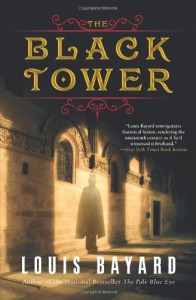
The Black Tower
bookshelves: books-with-a-passport, published-2008, spring-2010, france, historical-fiction, mystery-thriller
I'm a man of a certain age - old enough to have been every kind of fool - and I find to my surprise that the only counsel I have to pass on is this: Never let your name be found in a dead man's trousers.
Dear M was reading the blurb on the back of this book and exclaimed "Hah! we have a DVD film called Vidocq - in French with Swedish sub-titles."
----------------------
World's First Detective
François Eugène Vidocq was not a fictional detective... but he might as well have been, for all we really know about him! He was the model for Honoré de Balzac's Vautrin and Emile Gaboriau's Lecoq... (and some say for Sherlock Holmes, Inspector Maigret and Sam Spade, as well!) and much of what is "actually known" about him is based on works by unknown authors... including his famed autobiography!
"François Eugène Vidocq was an ex-convict who set up the Brigade de la Sûreté, the French national detective police force, and went on to become the world's first private detective. Here are a few of this real-life master sleuth's innovations:
He used disguises, decoys, and criminal stool pigeons
He experimented with fingerprinting
He invented invisible inks
He kept detailed files on criminals
He conducted blood and ballistics tests
He pioneered handwriting analysis.
Vidocq. The name strikes terror in the Parisian underworld of 1818. As founder and chief of a newly created plainclothes police force, Vidocq has used his mastery of disguise and surveillance to capture some of France’s most notorious and elusive criminals. Now he is hot on the trail of a tantalizing mystery—the fate of the young dauphin Louis-Charles, son of Marie-Antoinette and King Louis XVI.
Hector Carpentier, a medical student, lives with his widowed mother in her once-genteel home, now a boardinghouse, in Paris’s Latin Quarter, helping the family make ends meet in the politically perilous days of the restoration. Three blocks away, a man has been murdered, and Hector’s name has been found on a scrap of paper in the dead man’s pocket: a case for the unparalleled deductive skills of Eugène François Vidocq, the most feared man in the Paris police. At first suspicious of Hector’s role in the murder, Vidocq gradually draws him into an exhilarating—and dangerous—search that leads them to the true story of what happened to the son of the murdered royal family.
Officially, the Dauphin died a brutal death in Paris’s dreaded Temple—a menacing black tower from which there could have been no escape—but speculation has long persisted that the ten-year-old heir may have been smuggled out of his prison cell. When Hector and Vidocq stumble across a man with no memory of who he is, they begin to wonder if he is the Dauphin himself, come back from the dead. Their suspicions deepen with the discovery of a diary that reveals Hector’s own shocking link to the boy in the tower—and leaves him bound and determined to see justice done, no matter the cost.
 1
1